 |
Deepity
Ultra-fast, SIMD-accelerated Predictive Coding
|
|
Deepity
Ultra-fast, SIMD-accelerated Predictive Coding
|
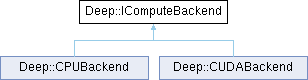
Device-agnostic compute backend interface: every numerical primitive a layer/network needs, implemented once each by CPUBackend (SIMD/BLAS) and CUDABackend (kernels/cuBLAS/CUTLASS), so layer code never branches on device directly. More...
#include <IComputeBackend.h>
Public Member Functions | |
| virtual | ~IComputeBackend ()=default |
| virtual void | BeginGraphCapture () noexcept=0 |
| Starts recording subsequent backend calls into a replayable graph, instead of executing them immediately (CUDA graph capture; a no-op record on CPUBackend). Pair with EndGraphCapture(). | |
| virtual bool | EndGraphCapture () noexcept=0 |
| Ends capture and instantiates the captured graph. | |
| virtual void | ReplayGraph () noexcept=0 |
| Launches a graph previously captured and instantiated by BeginGraphCapture()/EndGraphCapture(). No-op if EndGraphCapture() never returned true. | |
| virtual float * | Allocate (size_t numFloats)=0 |
| Allocates numFloats floats on this backend's device. | |
| virtual void | Free (float *ptr) noexcept=0 |
| Frees a buffer previously returned by Allocate(). No-op on nullptr. | |
| virtual void | Zero (float *ptr, size_t numFloats) noexcept=0 |
| Zero-fills numFloats floats starting at ptr. | |
| virtual void | Copy (float *dst, const float *src, size_t numFloats) noexcept=0 |
| Copies numFloats floats from src to dst, both on this backend's own device. | |
| virtual void | CopyFromHost (float *deviceDst, const float *hostSrc, size_t numFloats) noexcept=0 |
| Copies numFloats floats from a host buffer into a device buffer (a plain memcpy on CPUBackend). | |
| virtual void | CopyToHost (float *hostDst, const float *deviceSrc, size_t numFloats) noexcept=0 |
| Copies numFloats floats from a device buffer into a host buffer (a plain memcpy on CPUBackend). | |
| virtual void | RandomizeNormal (float *buf, size_t n, float mean, float stddev, uint32_t seed) noexcept=0 |
| Fills n floats with samples from a normal distribution. | |
| virtual void | RandomizeUniform (float *buf, size_t n, float min, float max, uint32_t seed) noexcept=0 |
| Fills n floats with samples from a uniform distribution over [min, max). | |
| virtual void | PrepareForBatchSize (size_t batchSize) noexcept=0 |
| Must be called once, before Compile()'s first BeginGraphCapture(), for any backend that needs to prepare batch-size-dependent state (e.g. CUDABackend's cached all-ones vector for SumRows' GEMV). No-op on CPUBackend. | |
| virtual void | MatMul (bool transA, bool transB, int M, int N, int K, float alpha, const float *A, int lda, const float *B, int ldb, float beta, float *C, int ldc) noexcept=0 |
| C = alpha * op(A) * op(B) + beta * C, the standard BLAS SGEMM convention (op(X) = X^T if the matching transX is true). | |
| virtual void | SumRows (float *dst, const float *src, size_t batchSize, size_t width) noexcept=0 |
| dst[j] = sum over b in [0,batchSize) of src[b*width + j], for all j in [0,width). Replaces a batchSize-iteration loop of individual AxpyInto calls – the reduction-direction counterpart to AddBiasBroadcast, still unfixed until now. On GPU this is one cublasSgemv call against a cached all-ones vector, reinterpreting src's row-major [batchSize,width] layout as column-major [width,batchSize] with no data movement (verified numerically). | |
| virtual void | Scale (float *buf, size_t n, float alpha) noexcept=0 |
| buf[i] *= alpha for all i in [0, n). | |
| virtual void | AxpyInto (float *y, const float *x, size_t n, float alpha) noexcept=0 |
| y[i] += alpha * x[i] for all i in [0, n) – the standard AXPY. | |
| virtual void | AddBiasBroadcast (float *buf, const float *bias, size_t batchSize, size_t width) noexcept=0 |
| buf[row*width + col] += bias[col] for every row in [0,batchSize) and col in [0,width) – broadcasts a per-column bias across every row (the dense-layer convention). | |
| virtual void | Activation (ActivationType type, float *buf, size_t n) noexcept=0 |
| Applies type to buf in place. | |
| virtual void | ActivationInto (ActivationType type, float *dst, const float *src, size_t n) noexcept=0 |
| Two-buffer variant of Activation(): reads src, writes into dst. | |
| virtual void | ActivationDerivative (ActivationType type, float *buf, size_t n, bool activated) noexcept=0 |
| Applies type's derivative to buf in place. | |
| virtual void | ActivationDerivativeInto (ActivationType type, float *dst, const float *src, size_t n) noexcept=0 |
| Two-buffer variant of ActivationDerivative(): reads src (the pre-activation value), writes the derivative into dst. | |
| virtual void | FusedStateUpdateMomentum (float *z, float *v, const float *feedback, const float *deriv, const float *e, size_t n, float ir, float beta) noexcept=0 |
| Same as FusedStateUpdate, but with momentum: the update direction (feedback*deriv - e) is EMA-smoothed into v (same shape as z, persistent across settling steps within one TrainStep(), reset to zero at the start of each call) before being applied to z. beta is the EMA decay (0.9 is a common default – higher = more smoothing/inertia). v = beta*v + (1-beta)*((feedback*deriv) - e) z += ir*v. | |
| virtual void | FusedStateUpdate (float *z, const float *feedback, const float *deriv, const float *e, size_t n, float ir) noexcept=0 |
| One settling step's state update, fused into a single call: z += ir * ((feedback * deriv) - e) Non-momentum counterpart to FusedStateUpdateMomentum() above. | |
| virtual float | ComputeErrorAndEnergy (float *e, const float *z, const float *mu, size_t n) noexcept=0 |
| Computes e = z - mu, then returns 0.5 * sum(e^2) – the Gaussian error/energy used by every layer except a cross-entropy terminal. | |
| virtual void | ComputeError (float *e, const float *z, const float *mu, size_t n) noexcept=0 |
| Same as ComputeErrorAndEnergy(), without computing (or returning) the energy – for callers that only need e. | |
| virtual float | ComputeSoftmaxCrossEntropyErrorAndEnergy (float *e, const float *z, const float *mu, size_t batchSize, size_t nextSize, float *rowEnergies) noexcept=0 |
| Softmax cross-entropy variant of ComputeErrorAndEnergy, for the terminal layer only. Unlike the Gaussian version, this needs batchSize/nextSize separately (not just a flat n) since softmax is a row-wise, not element-wise, operation. probs = softmax(mu), row-wise e = z - probs (z is the clamped target; matches the existing e := -dF/dmu convention exactly, since d(CE)/d(logits) = probs - y) energy = -sum(z * log(probs + eps)) (eps=1e-8, avoids log(0)) mu holds the RAW LOGITS (unchanged from the Gaussian case, still a*W@phi(z)+b) – softmax is applied here, not baked into mu itself. rowEnergies is caller-provided scratch, >= batchSize floats – NOT allocated internally (this runs inside CalculateState(), which runs inside TrainStep()'s CUDA-graph-captured region; dynamic allocation there is unsafe under capture, same reasoning as the CUTLASS workspace). CPUBackend's own override ignores this parameter entirely – kept in the shared interface so callers pass the same arguments to either backend. | |
| virtual void | ComputeSoftmaxCrossEntropyError (float *e, const float *z, const float *mu, size_t batchSize, size_t nextSize) noexcept=0 |
| Same as ComputeSoftmaxCrossEntropyErrorAndEnergy(), without computing (or requiring rowEnergies for) the energy – for callers that only need e. | |
| virtual bool | TryFusedForwardPass (ActivationType actType, const float *zF, const float *W, const float *bias, float *mu, int batchSize, int size, int nextSize) noexcept=0 |
| Attempts a fused forward pass (GEMM + bias + activation in one kernel, via CUTLASS on GPU) for RELU or LINEAR activation types only – see CUDABackend's implementation for why other activation types aren't attempted yet. Returns true if the fused path was used (mu is fully computed, including bias and activation); false if the caller should fall back to the existing MatMul+AddBiasBroadcast+ Activation sequence (always false on CPUBackend – CPU has no fused path, this is a GPU-only optimization). | |
| virtual void | Im2Col (const float *input, int channels, int height, int width, int kernelH, int kernelW, int strideH, int strideW, int padH, int padW, float *columns) noexcept=0 |
Rearranges a single (channels, height, width) input image into a (channels*kH*kW, outH*outW) column matrix – the standard im2col transform. NOT batch-aware: call once per batch item, with input and columns offset to that item's slice, matching Deep::Im2Col's own documented contract exactly (CPUBackend forwards to it directly). Positions outside the input (due to padding) are written as zero. columns is fully overwritten, not accumulated into. | |
| virtual void | Col2Im (const float *columns, int channels, int height, int width, int kernelH, int kernelW, int strideH, int strideW, int padH, int padW, float *outputImage) noexcept=0 |
The adjoint of Im2Col(): scatters a (channels*kH*kW, outH*outW) column-gradient buffer back into a (channels, height, width) image. NOT batch-aware, same per-item-offset contract as Im2Col(). ACCUMULATES into outputImage (does not zero it first) – caller must zero the destination if a fresh result is wanted, matching Deep::Col2Im's own contract exactly. | |
| virtual void | RepackForBatchedGemm (float *dst, const float *src, size_t batchSize, size_t rows, size_t cols) noexcept=0 |
| Repacks a [batchSize, rows, cols] tensor (batch-major) into [rows, batchSize, cols] (row-major, batch second) – i.e. dst[row][batch][col] = src[batch][row][col] for all row/batch/col, with the innermost cols dimension kept contiguous on both sides. Used by ConvPCLayer-family layers to reorganize per-batch im2col columns (and per-batch upstream-error columns) into the single flat layout a plain (non-batched) GEMM call needs, rather than one GEMM call per batch item. Same "port first, optimize" position as AddBiasBroadcast/SumRows: a future strided-batched-GEMM path could remove the need for this entirely, but this matches the existing, verified CPU repacking loops exactly for now. | |
| virtual void | IncrementCounter (int *counter) noexcept=0 |
| Atomically increments *counter by 1. Device-resident so it can be read/updated by the same kernel/graph across settling steps (e.g. Adam's step count t) without a host round-trip. | |
| virtual void | AdamStep (float *param, const float *grad, float *m, float *v, size_t n, const int *t, const float *lr, float beta1=0.9f, float beta2=0.999f, float eps=1e-8f) noexcept=0 |
| Adam update for n parameters in place. | |
| virtual void | AdamWStep (float *param, const float *grad, float *m, float *v, size_t n, const int *t, const float *lr, float weightDecay, float beta1=0.9f, float beta2=0.999f, float eps=1e-8f) noexcept=0 |
| Same as AdamStep(), plus decoupled weight decay (AdamW): param -= lr * weightDecay * param, applied before the Adam step itself. | |
| virtual DeviceType | GetDeviceType () const noexcept=0 |
| Which device this backend instance runs on. | |
| virtual void | MultiplyInto (float *dst, const float *a, const float *b, size_t n) noexcept=0 |
| dst[i] = a[i] * b[i] for all i in [0, n) – elementwise product. | |
| virtual void | Fill (float *buf, size_t n, float value) noexcept=0 |
| buf[i] = value for all i in [0, n). | |
| virtual void | AddBiasPerChannel (float *buf, const float *bias, size_t channels, size_t spatialSize) noexcept=0 |
Convolutional bias-add: buf[c*spatialSize + s] += bias[c] for all c in [0,channels), s in [0,spatialSize). Per-CHANNEL broadcast across spatial positions – the transpose relationship to AddBiasBroadcast (which broadcasts a per-COLUMN bias across ROWS, the dense-layer convention). NOT batch-aware: matches Im2Col/ Col2Im's contract exactly – call once per batch item, with buf offset to that item's slice. | |
Device-agnostic compute backend interface: every numerical primitive a layer/network needs, implemented once each by CPUBackend (SIMD/BLAS) and CUDABackend (kernels/cuBLAS/CUTLASS), so layer code never branches on device directly.
|
virtualdefault |
|
pure virtualnoexcept |
Applies type to buf in place.
Implemented in Deep::CPUBackend, and Deep::CUDABackend.
|
pure virtualnoexcept |
Applies type's derivative to buf in place.
| type | Which activation's derivative to apply. |
| buf | Array to derive in place. |
| n | Length of buf. |
| activated | If true, buf already holds the activated value; if false, buf holds the pre-activation value. |
Implemented in Deep::CPUBackend, and Deep::CUDABackend.
|
pure virtualnoexcept |
Two-buffer variant of ActivationDerivative(): reads src (the pre-activation value), writes the derivative into dst.
Implemented in Deep::CPUBackend, and Deep::CUDABackend.
|
pure virtualnoexcept |
Two-buffer variant of Activation(): reads src, writes into dst.
Implemented in Deep::CPUBackend, and Deep::CUDABackend.
|
pure virtualnoexcept |
Adam update for n parameters in place.
| param | Parameters to update. |
| grad | Gradient w.r.t. param. |
| m | Adam's first-moment (momentum) buffer, persistent across calls. |
| v | Adam's second-moment (variance) buffer, persistent across calls. |
| n | Number of parameters. |
| t | Device-resident step count (read, not written, here – see IncrementCounter()). |
| lr | Device-resident learning rate. |
| beta1,beta2 | Momentum/variance EMA decay rates. |
| eps | Denominator stabilizer. |
Implemented in Deep::CPUBackend, and Deep::CUDABackend.
|
pure virtualnoexcept |
Same as AdamStep(), plus decoupled weight decay (AdamW): param -= lr * weightDecay * param, applied before the Adam step itself.
Implemented in Deep::CPUBackend, and Deep::CUDABackend.
|
pure virtualnoexcept |
buf[row*width + col] += bias[col] for every row in [0,batchSize) and col in [0,width) – broadcasts a per-column bias across every row (the dense-layer convention).
Implemented in Deep::CPUBackend, and Deep::CUDABackend.
|
pure virtualnoexcept |
Convolutional bias-add: buf[c*spatialSize + s] += bias[c] for all c in [0,channels), s in [0,spatialSize). Per-CHANNEL broadcast across spatial positions – the transpose relationship to AddBiasBroadcast (which broadcasts a per-COLUMN bias across ROWS, the dense-layer convention). NOT batch-aware: matches Im2Col/ Col2Im's contract exactly – call once per batch item, with buf offset to that item's slice.
Implemented in Deep::CPUBackend, and Deep::CUDABackend.
|
pure virtual |
Allocates numFloats floats on this backend's device.
Implemented in Deep::CPUBackend, and Deep::CUDABackend.
|
pure virtualnoexcept |
y[i] += alpha * x[i] for all i in [0, n) – the standard AXPY.
Implemented in Deep::CPUBackend, and Deep::CUDABackend.
|
pure virtualnoexcept |
Starts recording subsequent backend calls into a replayable graph, instead of executing them immediately (CUDA graph capture; a no-op record on CPUBackend). Pair with EndGraphCapture().
Implemented in Deep::CPUBackend, and Deep::CUDABackend.
|
pure virtualnoexcept |
The adjoint of Im2Col(): scatters a (channels*kH*kW, outH*outW) column-gradient buffer back into a (channels, height, width) image. NOT batch-aware, same per-item-offset contract as Im2Col(). ACCUMULATES into outputImage (does not zero it first) – caller must zero the destination if a fresh result is wanted, matching Deep::Col2Im's own contract exactly.
Implemented in Deep::CPUBackend, and Deep::CUDABackend.
|
pure virtualnoexcept |
Same as ComputeErrorAndEnergy(), without computing (or returning) the energy – for callers that only need e.
Implemented in Deep::CPUBackend, and Deep::CUDABackend.
|
pure virtualnoexcept |
Computes e = z - mu, then returns 0.5 * sum(e^2) – the Gaussian error/energy used by every layer except a cross-entropy terminal.
Implemented in Deep::CPUBackend, and Deep::CUDABackend.
|
pure virtualnoexcept |
Same as ComputeSoftmaxCrossEntropyErrorAndEnergy(), without computing (or requiring rowEnergies for) the energy – for callers that only need e.
Implemented in Deep::CPUBackend, and Deep::CUDABackend.
|
pure virtualnoexcept |
Softmax cross-entropy variant of ComputeErrorAndEnergy, for the terminal layer only. Unlike the Gaussian version, this needs batchSize/nextSize separately (not just a flat n) since softmax is a row-wise, not element-wise, operation. probs = softmax(mu), row-wise e = z - probs (z is the clamped target; matches the existing e := -dF/dmu convention exactly, since d(CE)/d(logits) = probs - y) energy = -sum(z * log(probs + eps)) (eps=1e-8, avoids log(0)) mu holds the RAW LOGITS (unchanged from the Gaussian case, still a*W@phi(z)+b) – softmax is applied here, not baked into mu itself. rowEnergies is caller-provided scratch, >= batchSize floats – NOT allocated internally (this runs inside CalculateState(), which runs inside TrainStep()'s CUDA-graph-captured region; dynamic allocation there is unsafe under capture, same reasoning as the CUTLASS workspace). CPUBackend's own override ignores this parameter entirely – kept in the shared interface so callers pass the same arguments to either backend.
Implemented in Deep::CPUBackend, and Deep::CUDABackend.
|
pure virtualnoexcept |
Copies numFloats floats from src to dst, both on this backend's own device.
Implemented in Deep::CPUBackend, and Deep::CUDABackend.
|
pure virtualnoexcept |
Copies numFloats floats from a host buffer into a device buffer (a plain memcpy on CPUBackend).
Implemented in Deep::CPUBackend, and Deep::CUDABackend.
|
pure virtualnoexcept |
Copies numFloats floats from a device buffer into a host buffer (a plain memcpy on CPUBackend).
Implemented in Deep::CPUBackend, and Deep::CUDABackend.
|
pure virtualnoexcept |
Ends capture and instantiates the captured graph.
Implemented in Deep::CPUBackend, and Deep::CUDABackend.
|
pure virtualnoexcept |
buf[i] = value for all i in [0, n).
Implemented in Deep::CPUBackend, and Deep::CUDABackend.
|
pure virtualnoexcept |
Frees a buffer previously returned by Allocate(). No-op on nullptr.
Implemented in Deep::CPUBackend, and Deep::CUDABackend.
|
pure virtualnoexcept |
One settling step's state update, fused into a single call: z += ir * ((feedback * deriv) - e) Non-momentum counterpart to FusedStateUpdateMomentum() above.
Implemented in Deep::CPUBackend, and Deep::CUDABackend.
|
pure virtualnoexcept |
Same as FusedStateUpdate, but with momentum: the update direction (feedback*deriv - e) is EMA-smoothed into v (same shape as z, persistent across settling steps within one TrainStep(), reset to zero at the start of each call) before being applied to z. beta is the EMA decay (0.9 is a common default – higher = more smoothing/inertia). v = beta*v + (1-beta)*((feedback*deriv) - e) z += ir*v.
Implemented in Deep::CPUBackend, and Deep::CUDABackend.
|
pure virtualnoexcept |
Which device this backend instance runs on.
Implemented in Deep::CPUBackend, and Deep::CUDABackend.
|
pure virtualnoexcept |
Rearranges a single (channels, height, width) input image into a (channels*kH*kW, outH*outW) column matrix – the standard im2col transform. NOT batch-aware: call once per batch item, with input and columns offset to that item's slice, matching Deep::Im2Col's own documented contract exactly (CPUBackend forwards to it directly). Positions outside the input (due to padding) are written as zero. columns is fully overwritten, not accumulated into.
Implemented in Deep::CPUBackend, and Deep::CUDABackend.
|
pure virtualnoexcept |
Atomically increments *counter by 1. Device-resident so it can be read/updated by the same kernel/graph across settling steps (e.g. Adam's step count t) without a host round-trip.
Implemented in Deep::CPUBackend, and Deep::CUDABackend.
|
pure virtualnoexcept |
C = alpha * op(A) * op(B) + beta * C, the standard BLAS SGEMM convention (op(X) = X^T if the matching transX is true).
| transA | Whether to transpose A. |
| transB | Whether to transpose B. |
| M | Rows of op(A) and C. |
| N | Columns of op(B) and C. |
| K | Columns of op(A), rows of op(B). |
| alpha | Scalar multiplied into op(A)*op(B). |
| A | Left operand. |
| lda,ldb,ldc | Leading dimensions of A, B, C respectively. |
| B | Right operand. |
| beta | Scalar multiplied into the existing C before accumulating. |
| C | Output; also read if beta != 0. |
Implemented in Deep::CPUBackend, and Deep::CUDABackend.
|
pure virtualnoexcept |
dst[i] = a[i] * b[i] for all i in [0, n) – elementwise product.
Implemented in Deep::CPUBackend, and Deep::CUDABackend.
|
pure virtualnoexcept |
Must be called once, before Compile()'s first BeginGraphCapture(), for any backend that needs to prepare batch-size-dependent state (e.g. CUDABackend's cached all-ones vector for SumRows' GEMV). No-op on CPUBackend.
Implemented in Deep::CPUBackend, and Deep::CUDABackend.
|
pure virtualnoexcept |
Fills n floats with samples from a normal distribution.
| buf | Buffer to fill. |
| n | Number of floats to fill. |
| mean | Distribution mean. |
| stddev | Distribution standard deviation. |
| seed | RNG seed. |
Implemented in Deep::CPUBackend, and Deep::CUDABackend.
|
pure virtualnoexcept |
Fills n floats with samples from a uniform distribution over [min, max).
| buf | Buffer to fill. |
| n | Number of floats to fill. |
| min | Distribution lower bound (inclusive). |
| max | Distribution upper bound (exclusive). |
| seed | RNG seed. |
Implemented in Deep::CPUBackend, and Deep::CUDABackend.
|
pure virtualnoexcept |
Repacks a [batchSize, rows, cols] tensor (batch-major) into [rows, batchSize, cols] (row-major, batch second) – i.e. dst[row][batch][col] = src[batch][row][col] for all row/batch/col, with the innermost cols dimension kept contiguous on both sides. Used by ConvPCLayer-family layers to reorganize per-batch im2col columns (and per-batch upstream-error columns) into the single flat layout a plain (non-batched) GEMM call needs, rather than one GEMM call per batch item. Same "port first, optimize" position as AddBiasBroadcast/SumRows: a future strided-batched-GEMM path could remove the need for this entirely, but this matches the existing, verified CPU repacking loops exactly for now.
Implemented in Deep::CPUBackend, and Deep::CUDABackend.
|
pure virtualnoexcept |
Launches a graph previously captured and instantiated by BeginGraphCapture()/EndGraphCapture(). No-op if EndGraphCapture() never returned true.
Implemented in Deep::CPUBackend, and Deep::CUDABackend.
|
pure virtualnoexcept |
buf[i] *= alpha for all i in [0, n).
Implemented in Deep::CPUBackend, and Deep::CUDABackend.
|
pure virtualnoexcept |
dst[j] = sum over b in [0,batchSize) of src[b*width + j], for all j in [0,width). Replaces a batchSize-iteration loop of individual AxpyInto calls – the reduction-direction counterpart to AddBiasBroadcast, still unfixed until now. On GPU this is one cublasSgemv call against a cached all-ones vector, reinterpreting src's row-major [batchSize,width] layout as column-major [width,batchSize] with no data movement (verified numerically).
Implemented in Deep::CPUBackend, and Deep::CUDABackend.
|
pure virtualnoexcept |
Attempts a fused forward pass (GEMM + bias + activation in one kernel, via CUTLASS on GPU) for RELU or LINEAR activation types only – see CUDABackend's implementation for why other activation types aren't attempted yet. Returns true if the fused path was used (mu is fully computed, including bias and activation); false if the caller should fall back to the existing MatMul+AddBiasBroadcast+ Activation sequence (always false on CPUBackend – CPU has no fused path, this is a GPU-only optimization).
| actType | Activation to fuse in; only RELU and LINEAR take the fused path, everything else returns false immediately. |
| zF | Activated input, shape [batchSize, size], row-major. |
| W | Weight matrix, shape [nextSize, size], row-major. |
| bias | Bias vector, shape [nextSize]. |
| mu | Output, shape [batchSize, nextSize], row-major. Only written if this returns true. |
| batchSize | Number of rows in zF/mu. |
| size | Input width (columns of zF, columns of W). |
| nextSize | Output width (rows of W, columns of mu, length of bias). |
Implemented in Deep::CPUBackend, and Deep::CUDABackend.
|
pure virtualnoexcept |
Zero-fills numFloats floats starting at ptr.
Implemented in Deep::CPUBackend, and Deep::CUDABackend.
 1.16.1